
Our composition expert explains a simple technique which will help you create deep house chord progressions with ease.
Practically every genre of music relies on its own set of techniques, tricks and quick cheats to help create a distinctive sound. One of the trademark characteristics of deep house is its use of jazz-influenced minor and major 7chords, helping to give tracks a strong chord-led feel. In this article we’ll explain exactly what 7 chords are, how to construct them and finally how to use them in your own productions.
A 7 chord contains the root note, the 3rd, the 5th and the 7th of the scale. Going back to basics, a scale can either be major or minor. The difference between major and minor scales can be seen and heard here:

The presence of the major or minor 3rd determines which note forms the corresponding 7th of the chord. As shown above, in a natural C minor scale, the 7th is a Bb, whereas in a C major scale the 7th is B. So, the C major 7 chord would contain C, E, G and B:
While the C minor 7 chord would contain C, Eb, G and Bb:
7s in deep house
Let’s put this theory into practice with a very basic four-bar deep house loop. In our first example we hear just two chords: an F major 7 and an E minor 7. Here in the piano roll for the loop we’ve colour-coded the notes: root (purple), 3rd (blue), 5th (yellow) and 7th (green).
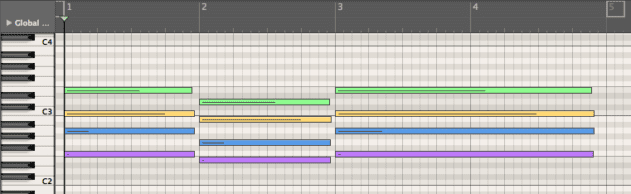
The result is a very simple but effective chord progression:
Masters at Work
Now let’s look at a more complex example. This time, we’ll focus on the MAW Dub mix of Masters At Work’s deep house classic ‘To Be In Love’, first released in 1997 and remixed and re-released countless times since.
Here we’ve transcribed the string loop from the intro, colour-coded as before: root, 3rd, 5th, 7th. Notes highlighted in red aren’t in the basic chords, but are added on top to form a simple melody.
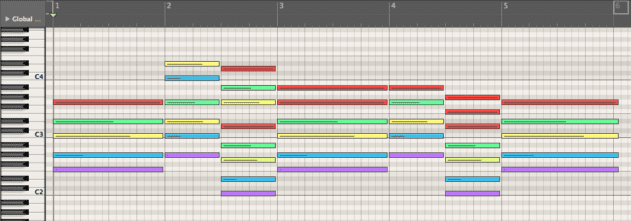
The string loop on its own sounds like this:
By concentrating on the lower notes here, we can see that the basis for this chord progression is the sequence F minor 7, Ab major 7, C minor 7. To make the progression cleaner and easier to follow, we could even get away with deleting some of the notes:
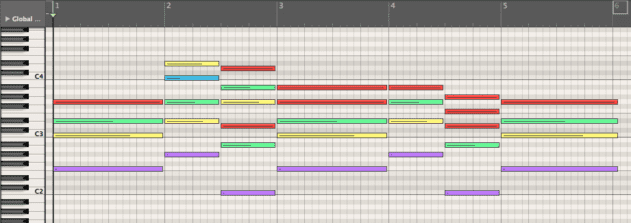
And here’s how it sounds:
The chords essentially sound the same, but they’re now a lot more clearly defined and will also be easier to mix. Notice that the 7th from each chord is left in.
Putting Theory Into Practice
In our final loop we have a simple minor chord progression A minor 7, E minor 7, D minor 7, colour-coded as before: root, 3rd, 5th, 7th:
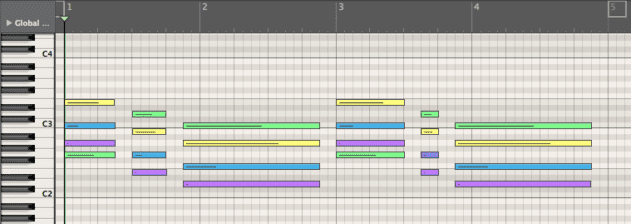
All the chords are still constructed using the root, minor 3rd, 5th and minor 7th, but we can see that the structure has been changed slightly. For the A minor 7 chords, we’ve moved the 7th down an octave. Altering the chords’ structure in this way keeps the notes closer together, helping the loop ‘flow’ and creating the descending E, D, C melody on top.
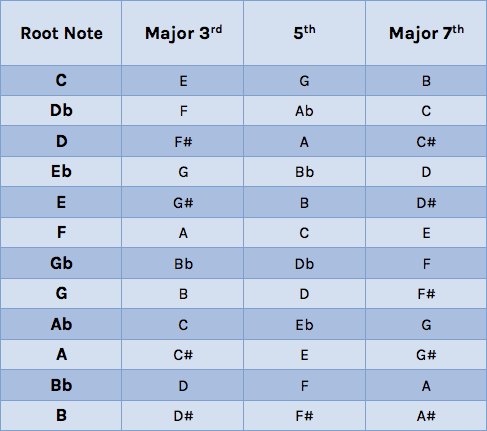
To help you get started creating your own progressions, here’s a list of all possible major 7 chords. To convert any of them into the minor 7 chord of the same root, simply lower both the 3rd and 7th a semitone.
Adding a few 7 chords into your progressions is one of the simplest tricks you can use to give your tracks an authentic deep house feel.
02.49 PM
Hats off that man for sharing something that sounds complex in a really nice explained way. I look forward to more like this.
06.21 AM
Simply beautiful tutorial. Love MAW, love Deep House, lovin ATTACK!
This could be the start of a beautiful relationship!
Thanks. =)
04.05 PM
Nice ONE !!!!
08.38 AM
Also looking forward to more like this, great work, can’t wait to have a play around with this 🙂
08.57 AM
It’s these kinds of tips that lift the fog
02.25 PM
Nice tut. I love the basics!
I thought I’d mention that chords and voicing are usually covered in music theory books/classes. If you can find it, Walter Pistons book of Harmony (It is OLD) can really put all of this into a easy to understand context. As long as we use the westen scale (a,b,c,d,e,f,g) it is useful to look back at the work of composers and theorists from out past – we stand on their shoulders.
12.25 AM
Nice one !
10.59 AM
I really love what you are doing! Keep up the good work 🙂
02.46 PM
It is really a cool and useful piece of information. I’m glad that you shared this useful info with us. Please keep us informed like this. Thanks for sharing.
07.47 PM
Great tutorial. Learnt a lot. Are there any rules as to how many notes you can move up/down an octave in a chord?
12.14 PM
Hey Coma,
Glad you found it useful.
I think you’re referring to changing the voicing of a chord (ie moving the different intervals of the chord up and down octaves but still keeping the actual notes the same).
It is possible that the context of the chord or the melody line above could be changed by its voicing. It’s often the highest and lowest notes in a chord that give context and melody.
For instance, a C minor 7 comprises the same notes as an Eb major add6 chord (C, Eb, G, Bb). If you play a C in the bass underneath it, it will generally sound like a C minor 7, if you play an Eb underneath it, the chord is still made up of the same notes, but the Eb in the bass will most likely make the chord above sound like an Eb major add6.
Generally the highest note in the chord will be the most noticeable one melodically.
For instance, play the notes G, Bb, C, Eb ascending, and it is still the same C minor 7 chord, but as the Eb is now the highest note it will probably be the most noticeable note melodically.
Hope this helps, we’ll be looking at changing chords with basslines more in a future Passing Notes.
Cheers,
Oliver
01.13 PM
bit on voicings here:
http://alijamieson.co.uk/theory/index.html
11.22 PM
Thanks for this.
08.58 PM
Thanks Oliver
05.32 AM
Thank you!
05.05 PM
And this isn’t specific to deep house, either. This article is basically telling you how to be more jazzy!
07.19 PM
Just wondering: say I wanted to construct a chord progression for a d sharp minor pentatonic scale, would I use the notes only from the pentatonic to construct the chords or would I use the notes from a d sharp natural minor scale? Just getting a bit confused here
09.51 AM
Indeed: You’d probably be safe using all the notes from a d sharp natural minor scale depending on how you want it to sound.
For instance, another frequent addition to 7th chords in deep house, is adding the 9th – as seen in the MAW example – and often the 11th too. Try a minor 7 adding the 9th and/or 11th on top (the 2nd / 4th above the 7th – in D sharp minor, it’s an F (E sharp) and a G sharp).
As the D minor pentatonic scale is just a stripped down D natural minor, the notes should still fit over any chord progression in that scale.
Hope this helps, cheers,
Oliver
04.10 PM
Great Oliver, thanks for getting back with the quick and clear response. I was confusing myself unnecessarily there, I don’t know why I didn’t of the pentatonic as being the same scale minus a couple of notes. That’s cleared it up
Great lessons keep up the good work
08.33 AM
Here a cool tool for you guys 😉 Plenty out there like this, But their a great tool. http://www.musictheory.net/calculators/chord
02.57 PM
Absolutely loved this one as well. Thanks for all the great features!
06.47 PM
Thanks, thats an awesome, thank you very much it means a lot to me as a deep house produce.r. Looking forward to more deep house tutorials./
02.19 PM
The best deep house tutorial I’ve come across lately. Chords are the heart and soul of deep house.
06.19 PM
KEEP IT UP! thank you 🙂
09.02 PM
just found this site today–not sure where the hell its been hiding. Great articles/tutorials!
bookmarked.
10.32 PM
Totally agree with all of the above. Simply outstanding and informative stuff here guys!
08.45 PM
Can’t believe I just discovered this. It’s brilliant. Thanks!
08.45 AM
I’m loving these tutorials. Not to detailed, not to long, not to short. Just perfect
Keep em’ coming
06.16 AM
Lovin it
12.42 PM
Nice looking forwad for mor tutorial like this…
08.13 AM
Fantastic article. I keep coming back to this.
05.12 PM
what key is that MAW track, when i check on beatport it says Fmaj but the way i see it from the screenshot above its in D#/Eb. I thought the chords determine the key signature.
Thanks
05.15 PM
From the way I see it its D#/Eb Maj.
02.22 PM
@Sphamandla – The track is in F minor. We can work this out easiest by ear, as the progression ‘resolves’ to an F minor chord. This doesn’t always mean the last chord of a progression denotes the key of a track, but in this case we can hear how the progression feels ‘finished’ on the F minor chord (actually an F minor 9). Ab major and C minor are also the 3rd and 5th chords from the F minor scale (although the ‘D’ in the C minor 9 and 13 chords would not be in F minor).
Where we’ve written that ‘the notes highlighted in red aren’t in the basic chords’, we are deliberately focusing on the 7 chords which lay the foundation for 9, 11 and 13 chords – some of which appear in the MAW progression. Our latest Passing Notes piece, ‘Further Chords’, discusses these chords in more detail.
Hope this is useful anyway!
Cheers,
Oliver
08.33 PM
Thanks a lot Oliver this was really a useful information.
06.42 AM
I just did some more reading on the matter, I found out that getting the key signature is the matter of finding a I chord, and in this case the I chord is F minor. The progression begins at F minor and “resolve” to F minor like you said. Interesting and thanks again for this great tutorial Oliva. Oh and this progression is not I-IV-V because of the Ab instead of Bb.
10.05 PM
I have a question. And by the way I’d happily pay for a few quick lessons on Skype from the main man here. If I create a song that I plan to be in C minor… You say the root if the chord has to be a C. Then from that C you great the chord as shown above. Does that mean u can only create that one chord of that kind in a sing that’s made in C minor. How that makes sense. This has always baffled me
02.20 AM
This bit is a gem. I’ve been working towards using chords and this really set off a green light in my creative process, kept hitting my head on the wall after I got a drum pattern down. Thanks.
03.25 PM
Great articles these and would be perfect for mobile consumption if you guys fixed the page loads. Basically there’s something on the page – probably an ad or a script that occasionally renders the music players inactive.
Sort this out please lads!
07.12 AM
LFOUFO – This seems to be a problem for only a very very small number of people. We can look into fixing it if you can let us know browser, device and OS. Thanks. Dave@Attack
04.09 PM
ma che bello!
12.25 PM
I can’t play the links either on my iPhone, think it’s something to do with java as Apple run their own java….could be wrong tho lol
With regards to the tutorial, thank you for a such clear explanation !!!
One question, I think Oliver touched on not having to finish on the I chord, I was just wondering when this was applicable or does it not matter ?
Thanks
12.30 AM
Grazie lo dico anche io
10.51 PM
You are brilliant.
That last shot of the chords was exactly an example of what I was looking for cause you didn’t just play the chords you showed visually how they were played inside the DAW.
This enabled me to be able to understand.
Thank you so much.
10.58 PM
Could I ask one thing,
So say the 8 bar loop would be with 2 @ the end to give the call and return release?
03.42 PM
Indeed, regarding your minor pentatonic question.
Use the natural minor scale for the chords as plus you won’t be able to create full triads from the minor pentatonic scale alone , apart from the i & iii chords. The minor pentatonic is great for melodies without tension tones & great for adding 5ths (4th below) for bluesy riffs. So from Am pentatonic scale, you can use the notes A,C,D & G with a 4th below each, e.g A with E below it. You then use the bVII (G) & IV (D) as pre cadence tones leading back to the Tonic A.
03.59 PM
In the MAW String loop the D notes in the third (Cm) chord are not in the key as D is not in the key of Fm, are all notes not supposed to be in the same key? Switching the 2 Ds to C# or D# makes the progression sound poor even though this brings every note into Fm, just wondering why this is, thanks – great article as usual
06.33 PM
I’ve just try with a sound like house chords in Cubase 5 wit Monologue,and start search the keys,and it works
08.44 AM
Thanks a lot! Reversing is the key 😉
12.42 AM
I think there is an error here : 7s Chord in deep house paragraph : Let’s put this theory into practice with a very basic four-bar deep house loop. In our first example we hear just two chords: an F major 7 and an E minor 7. Here in the piano roll for the loop we’ve colour-coded the notes: root (purple), 3rd (blue), 5th (yellow) and 7th (green).
Should be : Let’s put this theory into practice with a very basic four-bar deep house loop. In our first example we hear just two chords: an F major 7 and an E major 7. Here in the piano roll for the loop we’ve colour-coded the notes: root (purple), 3rd (blue), 5th (yellow) and 7th (green).
(TLDR : E major 7 instead of E minor 7)
Am I right ?
08.08 PM
HI Oliver,
Is there any advice on the progressions themselves? I.e how should one go about constructing one? Should we be following tried and tested progressions? Like I-IV-I all that sort of thing?
01.57 AM
Your first chord progression. F maj 7 and E min 7 , how come they are so effective, if they haven’t used the tonic? How do they resolve so well, this is the key of A min isn’t it?
11.48 AM
Just found this great article…only 5 years too late. The MAW tune is in F dorian, which is Fm with the raised sixth (D natural). We going to get any more of these?
06.26 AM
I always love playing piano and currently I teach as a piano instructor on elementary level and this is so much fun and well hard work but i love this job as I inspire a lot of students