
Dance music theory expert Oliver Curry explains some of the principles behind big room chord progressions.
Main room house is largely characterised by big, emotional minor chord progressions. In this edition of Passing Notes, we’re going back to basics and looking at the natural minor scale and some simple examples of minor chord progressions.
Firstly, we’ll look at the natural minor scale (which is also the Aeolian mode). We’ve used an A minor scale, simply because it just uses the white notes on our keyboard – A, B, C, D, E, F, G, A:
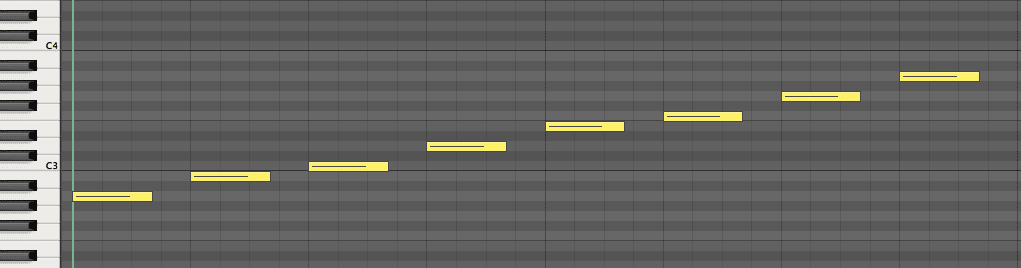
Using just the notes in the A minor scale, we can build the following seven chords: A minor 7 – B minor 7 flat 5 – C major 7 – D minor 7 – E minor 7 – F major 7 – G dominant 7 – A minor 7…
Which look like this:
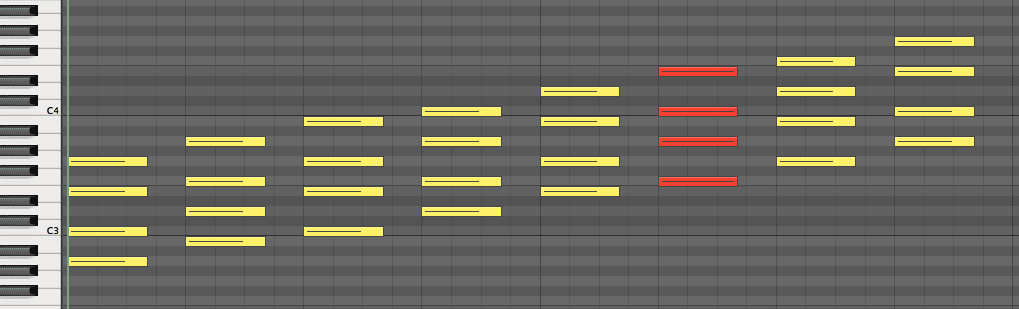
They sound like this:
In many cases these chords are simplified into triads (three-note chords) by omitting the 7ths: A minor – B diminished – C major – D minor – E minor – F major – G major – A minor…
These chords – and their equivalents in other keys – form the basis of the vast majority of main room house tracks.
(Remember that the exact chords will change depending on what key your track’s in. If you’re working in C minor, for example, the chords will be C minor 7, D minor 7 flat 5, Eb major 7, etc.)
The observant among you will already have noticed that in the piano roll above we’ve highlighted the sixth chord of the scale (in this case F major 7). As we’ll see, the use of the sixth chord of a minor scale plays a huge part in generating that emotion and anticipation so frequently found in main room house tracks.
Metropolis
For a great example of a main room chord progression in a natural minor key, listen to David Guetta and Nicky Romero’s collaboration ‘Metropolis’:
The track uses an ostinato, a technique we covered in a previous Passing Notes, but this time we’ll concentrate on the chords underneath it:
Here, we can see the 16-bar chord progression in A minor used throughout the piece, starting at 1:18:
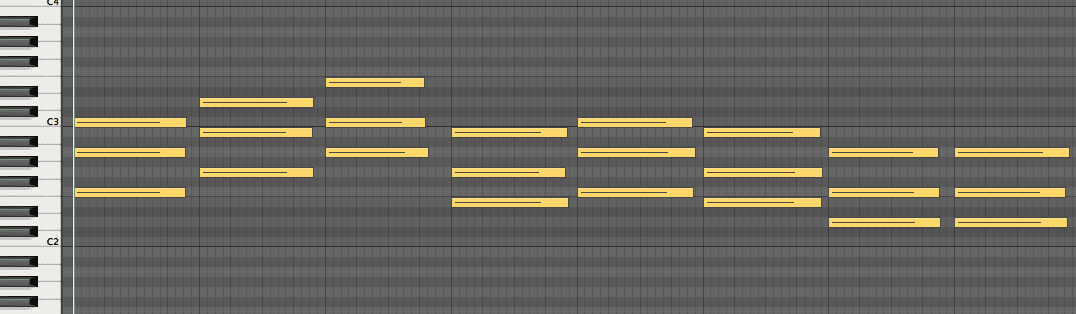
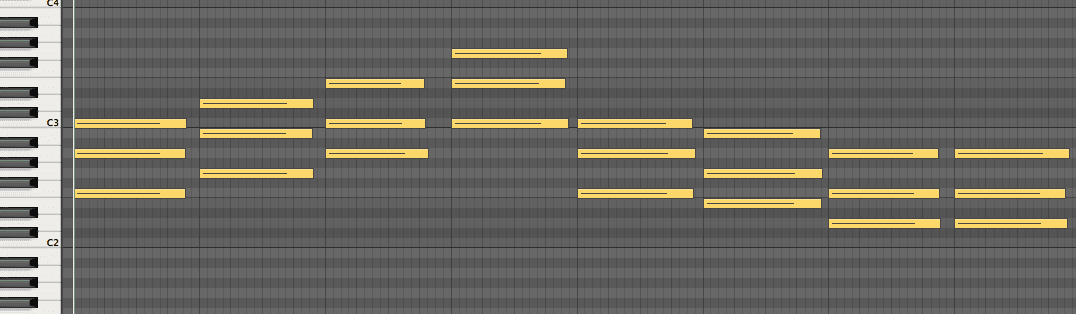
As mentioned earlier, it is the use of the sixth chord of the scale that so often provides the anticipation and ‘lifting’ feel to main room house progressions.
In this case, the F major is used to open each 4-bar progression. In the context of the key of A minor, this chord hints that the progression will resolve to A minor, as it’s built largely using an A minor chord. The 3rd and 5th – the A and C – are the root note and minor 3rd in an A minor chord. (‘Metropolis’ uses a straight F major chord rather than F major 7, but note that if the F major 7 had been used then the 7th – an E – would also be the 5th of the A minor chord.)
In the case of ‘Metropolis’, the F major chord – in conjunction with the use of the ostinato – helps give the track its ‘lift’ and defines the feel of the chord progression.
Next, let’s check out a couple of different examples of the same technique…
03.54 PM
Not my type of music at all but soem quite interesting ideas in this tutorial. Going to try experimenting with that idea of the Amin triad being the top notes of the Fmaj7 chord. Might work nicely to hold those notes then alternate between the F and the G or switch between A and F in the bass.
10.29 AM
nice article!
especially in the Hans Zimmer track it’s incredible how the change of one single chord lifts up the hole track/progression.
08.04 PM
good article! but is this really anything new when you think about it? music theory hasn’t changed in a long time, and the feelings that certain chord progressions haven’t changed much either (besides the sound/timbre/etc of the sound). i think the great artists are the ones who are masters of blending this classical knowledge with cutting-edge sound creation and production. also i love the example of the hans zimmer track… a great soundtrack can capture an abstract feeling indescribably well.
01.10 AM
hey spencer: why does it have to be new?
Its new to me!
02.38 PM
Interpreting the Inception track that way makes a lot of sense, and explains the effect of the Cmaj7 chord, but doesn’t it sound like the key center is A rather than E? In which case the lifting effect could be explained by the jump to the b in the melody and the tension between he b and c notes.
06.26 PM
Hey Fogworth,
The key centre sounds very strongly to be E minor (or G major) to me. In my opinion, one of the most powerful things about this particular chord progression is the fact that it doesn’t start or end on its tonic / key centre.
Also, from a theoretical perspective, if the key was A minor, the D chord would most likely be a D minor rather than a D major.
Either way, I’d certainly agree that both the tension between the B and the C in the C major 7 chord and the distance / dissonance between the C and B in the melody, are hugely effective.
Cheers!
Oliver
09.54 AM
Great tips!
10.39 PM
Another fantastic article that has explained things to me in a way that I can finally understand. So glad I’ve stumbled upon this site!
Great work guys!!
09.25 AM
GreatArticles on this magazine at all! Nice onnection between theory and practicing! Could you make an explanation on these really heavy electro Kickdrums?Basically its clear that its a kick with a sine wave behind it but it never fits as it should, so maybe you awesome guys can fix that lack of knowledge!
Cheers!
11.54 PM
As a guitar player coming to electronic music I find these passing notes articles really useful. Thank you, keep them
coming
03.12 PM
very nice thanxs!
07.55 PM
Hii….Can anybody help me with the 6th chord..whats exactly the 6th chord of a scale??
07.36 PM
Awesome! Thanks for the help xD
11.56 PM
Marc, the 6th chord is just the 6th note of a scale made into a triad chord “1st-3rd-5th”. In A minor , or most scales the 6th chord is played as a minor chord where the 3rd is played a half step down. Triads are made using FACEGBDFA …. . Take any note there and the two to the right make a triad. In these piano rolls they are inverted. So the root note or 1st note may be payed above the other notes in the chord. Chord charts are made up of the number from the scale.
scale of A minor
A B C D E F G A
1 2 3 4 5 6 7 8
This article might have been greatly simplified if it summarized each example with a chord chart and stated the chords in each piano roll instead of just the picture. As i see it , and please don’t quote me, I just glanced through them , but on page one the example is A minor scale
A B C D E F G A
1 2 3 4 5 6 7 8
and piano roll show
F G A E , F E D D
or
6-7-1-5, 6-5-4-4
and the final example also in A minor is :
C G A E, F G A E
or
3 -7-1-5, 6-7-1-5
The Hans Zimmer example would be :
Eminor
E F G A B C D E
1 2 3 4 5 6 7 8
A minor – E minor – G major – D major, then … A minor – C major 7 – G major – D major
or
4-1-3-7, 4-6-3-7
For melody while each chord is playing, use the notes from that chord to make the melody and use passing tones as well.